
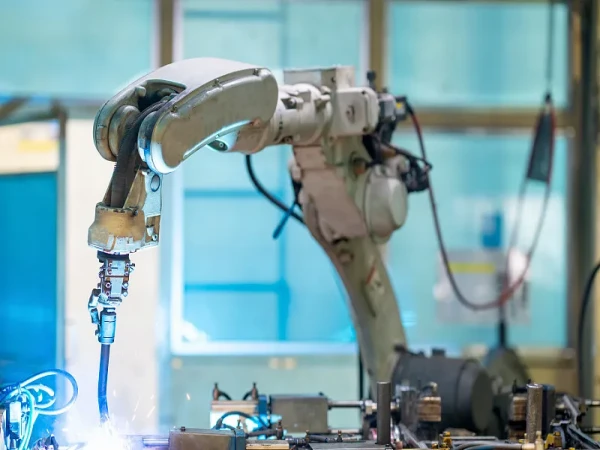
GLS Polishing and Grinding Robots

GLS robot technology has been recognized by Foxconn, Luxshare Precision, Shagang Group and other companies.

Full Analysis Of Polishing Robot Trust Indicators

The following data is used to quickly determine whether GLS has reached the maturity level that can be introduced into the production line.

Ra 0.05µm

Mirror accuracy, verified on Ti-6Al-4V titanium alloy implants

90%

Compared with manual processing, the scrap rate is reduced

300+

Robot integration projects completed since 2018

40+

Global service countries and regions

14 months

Average customer investment payback period

Manual Polishing Vs GLS Polishing Robot

The force of manual polishing fluctuates greatly, resulting in unstable quality and high losses; force-controlled polishing robots operate at constant pressure to achieve stable accuracy, reduce waste and increase efficiency.

Instability Of Manual Polishing

ScenarioContact ForceResult
1st Hour of Morning Shift4.8NRelatively stable contact force, yet with manual fluctuation still present
4th Hour of Morning Shift5.3NFatigue begins to accumulate, with pressure gradually rising
6th Hour of Night Shift6.7NPressure increased by 39%, with significantly higher risk of surface defects

±2N contact force fluctuations on aluminum alloy workpieces can result in Ra fluctuations, edge overpolishing, and scrap rates of 8%–20%.

Four Problems Solved by GLS

Pain PointActual CostGLS Outcome
Rework and scrap caused by inconsistent contact force8%–20% of parts require rework or scrappingCustomer-verified scrap rate <0.5%
Shortage of skilled polishing technicians3–6 months recruitment cycle, annual turnover rate over 30%Can supervise 2–3 robot cells after 2 days of training
Occupational health risks from dust, vibration and noiseApproximately ¥80,000–¥200,000 per occupational injury claimOperators are completely removed from hazardous work areas
Geometric deviation of parts from different batchesMissed weld seam grinding or over-polishing of deviated partsAutomatically compensates for part deviation of ±1mm

Core Technology About GLS Polishing Robot

The key differences between GLS and traditional grinding and polishing systems directly determine the rhythm, stability and quality traceability.

±0.05N force control accuracy

The six-axis sensor detects force at 1,000Hz and maintains stable contact on flat surfaces, curved surfaces, freeform surfaces, edges and corners.

12 Automatic tool change at work station

It can automatically switch between abrasive belts, grinding discs, polishing wheels, wool felt wheels and wire brushes, and the tool change time is only 5 seconds.

Robot vision system

3D structured light completes part positioning within 2 seconds, reducing fixture dependence and supporting flexible loading.

AI defect detection

Real-time identification of scratches, pores, insufficient material removal and surface defects based on 10,000+ industrial images.

Manual drag and drop teaching

Collaborative robots can be directly dragged for teaching, and complex path recording can be shortened from days to minutes.

MES production traceability

Record force control curve, tool status, Ra prediction value, operator ID and processing results, support OPC-UA and Modbus TCP.

Offline programming

After importing CAD, selecting the surface, and setting the target Ra, the path is automatically generated, which is 70% faster than teaching pendant programming.

Tool wear compensation

Continuously track abrasive attenuation and adjust contact force to ensure stable material removal rate and reduce manual parameter adjustment.

When Is It Worth Investing In A Polishing Robot?

GLS will directly determine whether your current factory is suitable for automation to prevent customers from making wrong investment decisions.

Suitable for deployment of grinding and polishing robots

Monthly output of the same type of parts >200 pieces, Changeover costs are often still covered by automation benefits.

Current scrap or rework rate exceeds 5% ,The force control system has the most obvious saving effect in this type of scenario.

Part process flow can be copied, Robots are best suited for replicating stable processes rather than replacing disorderly operations.

Batch geometric deviation is controlled within ±1mm, Exceeding the range can still be solved, but will increase the cost of the vision system.

Loss of orders due to unstable surface quality ,The benefits of retaining orders and acquiring new orders are usually higher than simply saving labor.

Unsuitable Scenarios for Grinding & Polishing Robots

If the monthly output of the same type of parts is <50 pieces, standardize the process first, or use GLS semi-automatic auxiliary tools.

Pure artistic hand-made surface treatment, human aesthetic judgment cannot be completely parameterized.

The complex inner cavity structure cannot be reached, so it is recommended to turn to electrolytic polishing or vibration grinding.

If your budget is less than $15,000 and you need 6 months to pay back your investment, you can start with the GLS-EC5 collaborative robot.

The same kind of parts cannot be stably provided in the first 6 months, and the robot program needs a stable batch of parts for verification.

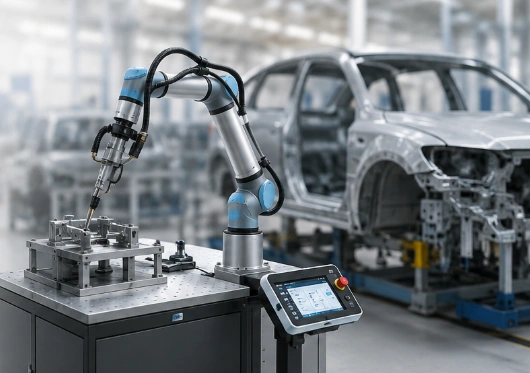
Advantages of Single Robot Welding Workstations

Choose the appropriate grinding or polishing process based on material, hardness and surface requirements.

MaterialHardnessProcess FlowSpindle SpeedAchievable RaRecommended GLS ModelKey Precautions
Aluminum Alloy 6061 / 7075HB 95–150Grinding → Polishing → Mirror Finishing3,000–8,000 RPMRa <0.1µmGLS-PG-2000T-ARisk of built-up edge (BUE) formation, regular cleaning required
Stainless Steel 304 / 316LHB 200Grinding → Fine Grinding → Brushing2,000–6,000 RPMRa 0.2µmGLS-PG-2000T-BPoor thermal conductivity; force control prevents overheating
Titanium Alloy Ti-6Al-4VHRC 36Low-speed Grinding → Precision Polishing800–2,000 RPMRa 0.05µmGLS-EC16High chemical reactivity; inert atmosphere is recommended
Brass C36000HB 80–120Polishing → Mirror Finishing2,000–5,000 RPMRa <0.1µmGLS-PG-800TSoft material; maximum contact force of 0.5N is recommended for mirror finishing
Carbon Steel Q235 / 45#HB 150–250Heavy Grinding → Surface Pretreatment1,500–4,000 RPMRa 1.6–3.2µmGLS-PG-3000LHigh material removal rate; torque monitoring is required
Cast Iron HT250HB 170–240Heavy Grinding → Surface Finishing1,000–3,000 RPMRa 0.8–1.6µmGLS-PG-2000T-BBrittle material; vibration control is required
PMMA / AcrylicShore D 85Fine Grinding → Polishing500–1,500 RPMRa 0.05µmGLS-EC5Low-speed processing avoids thermal deformation
Carbon Fiber Reinforced Polymer (CFRP)Trimming → Edge Finishing2,000–5,000 RPMRa 0.4µmGLS-PG-800THarmful dust generated; HEPA-sealed work station is mandatory
Zinc Alloy ADC12HB 80–100Deburring → Polishing → Mirror Finishing2,000–6,000 RPMRa <0.1µmGLS-PG-2000T-ASoft parting line; compliant control is critical

Features of GLS Polishing Robot

Each difference directly affects your product quality, production costs and competitive advantage

①±0.05N force control accuracy

The six-axis sensor detects force at a frequency of 1,000Hz, and the system can maintain stable contact force regardless of flat surfaces, curved surfaces, free-form surfaces, edges or corners. From the first part to the 10,000th part, the process parameters remain consistent.

②12-station automatic tool change

Supports automatic switching of abrasive belts, grinding discs, polishing wheels, wool felt wheels, and wire brushes. The entire finishing process does not require manual intervention or interruption of the processing cycle.

③Complete part positioning in 2 seconds

3D structured light scanning can identify the position and attitude of parts within 2 seconds, reducing the need for precision tooling and fixtures, supporting flexible loading and pallet-less production, and reducing changeover costs.

④AI defect detection (10,000+ training images)

Deep learning identifies scratches, pores, insufficient material removal, and grinding marks in real time. Partial regrinding is automatically triggered before the parts leave the workstation, with a false alarm rate of <0.8%.

⑤Speed up programming path generation by 70%

GLS Motion Studio generates and simulates grinding paths without stopping the line. Import CAD → select surface → set Ra → automatically generate path → simulation verification → export program, and the programming time is shortened from days to hours.

⑥MES integration: 100% production traceability

Each part generates timestamp records: force control curve, machining cycle, tool status, Ra prediction value, operator ID, quality results. Supports OPC-UA, Modbus TCP direct connection to MES/SCADA/ERP.

⑦Manual drag and drop teaching mode

The collaborative robot model supports direct dragging of the robot arm for teaching. The system records the motion trajectory and executes it repeatedly with ±0.05N force control accuracy, shortening complex path teaching from days to minutes.

⑧Automatically compensate for grinding tool wear

The system automatically detects the attenuation of the abrasive and adjusts the contact force. The processing effect of the old and new abrasive tools is consistent, the material removal amount is stable, the service life of the abrasive tools is extended, and manual parameter adjustment is reduced.

Polishing Robot Vision System

Our vision system reduces fixture costs and allows the machining process to form a complete quality closed loop.

Problem 1: Part location is uncertain

Each time manual loading occurs, the actual position of the part usually deviates from the robot’s preset position by ±5–15mm. Without a vision system, high-precision fixtures must be designed for each type of part.

GLS uses 3D structured light scanning to identify part position and orientation within 2 seconds and automatically corrects the processing path to support flexible loading and pallet-free production.

Question 2: Surface defect detection

The AI defect detection module is trained on more than 10,000 images of industrial surfaces and can identify scratches, blowholes, sanding marks, insufficient material removal and uneven surface preparation in real time.

After a defect is discovered, the system will automatically perform local regrinding of the abnormal area to avoid sending the problematic parts directly to the next process.

Polishing Robot Vision System Parameters

Adopts blue LED structured light 3D scanning. Max point cloud density reaches 4 million points per scan; typical workpiece scanning finishes within 2 seconds.

Position accuracy ±0.5mm, posture accuracy ±0.3°. Detects scratches wider than 0.05mm and pores over 0.3mm in diameter with a false alarm rate below 0.8%, validated on over 10,000 workpieces.

Supports integration with Keyence, Cognex, Basler and SICK, seamlessly connecting customers’ existing industrial cameras.

Delivers pass/fail judgments, defect mapping and predicted Ra values. Natively compatible with the official GLS robot software platform for easy integration.

Safety Protection Of Gls Polishing Robot

Surface finishing is one of the better industrial applications for collaborative robot deployment, and the GLS polishing robot has safety capabilities built into every layer.

Five-layer security architecture

✅ 1: Joint torque detection: Six-axis joint torque is continuously monitored and a safety stop is triggered within 50ms when the threshold is exceeded.

✅ 2: Speed and distance monitoring:The vehicle automatically slows down after entering the monitoring area and stops completely when in close contact.

✅ 3: Security Level Controller:Dual-channel safety PLC operates independently of the main motion controller and complies with ISO 13849-1 PL d, Category 3.

✅ 4: Force Control Limited Mode:Even if the parameters are wrong, the system will not exceed the set maximum contact force.

✅ 5: Physical Structural Design:Rounded casing, no pinch point structure, internal wiring, IP54, and emergency stop protection are all available.

Operators can complete it after 2 days of training

 ✓Select and load part program from recipe library
✓Monitor real-time contact force and position on HMI
✓Perform tool changes and condition checks
✓Start and confirm new formula prototypes
✓Perform basic fault diagnosis based on HMI alarm codes
✓Adjust contact force via touch screen within approved range
✓Use manual drag and drop teaching on collaborative robot models

GLS engineers still need to be involved

✗Create new recipes from scratch
✗Reconfigure security area
✗Calibrate force control parameters
✗Retrain the vision system model
GLS provides remote online support and on-site engineer services, all of which can be covered through service agreements.

GLS Robot Sensing Technology

ParameterSpecification
Force Control Range0.5N–200N, Configurable
Force Control Accuracy±0.05N
Sampling Frequency1,000Hz
Response Time<20 Microseconds
Abrasive Wear CompensationAutomatically tracks abrasive wear and adjusts contact force
Protection LevelIP67, Dustproof & Splash-proof

Two Proven Real- Projects

Real data, real customer feedback — not a demo environment, this is a production site

We had 5 manual polishers per shift and still had issues coming up every quarter during OEM surface quality audits. The scrapping cost alone reaches more than 50,000 US dollars per year. GLS passed its first OEM audit with zero issues after installing the GLS-PG-2000T-A. In the first month, the scrap rate dropped from 15% to 0.4%. We recouped our entire investment in 7 months, which was expected to take 14 months. Formula switching between wheel sizes literally only takes 30 seconds. I'm skeptical until I actually see the device in action.
James Wu Automotive Tier 1 Supplier Aluminum alloy wheel polishing, Suzhou area
Our main goal is not to save labor but to meet FDA traceability requirements. We need complete documentation of all finishing parameters for each implant. GLS is the only software platform among the systems we evaluated that can automatically generate complete records without the need for additional overlay quality systems. Ra 0.05µm has been stable for 18 months. There were zero incidents of contamination. In the past, the quality team needed to prepare materials for 3 days before each audit. Now it only takes 2 hours because all the data is automatically generated in advance.
Linda Chen, Medical Device OEM, Quality Director

Frequently Asked Questions

The standard GLS robot workstation will complete pre-assembly, pre-wiring, pre-debugging and factory testing in Zhangjiagang. On-site installation work includes: workstation positioning, power/air connection, part program loading, acceptance testing, and operator training. Installation cycle: .GLS-PG-800T:2-3 days ·GLS-EC series: 2-3 days ·GLS-PG-2000T series: 3-5 days ·GLS-PG-3000L (including conveyor line integration): 5-8 days Training occurs concurrently with installation, and operators can complete certification before the installation team leaves.

It can palletize cartons and bags, tend CNC machines, perform arc or spot welding, or assemble parts. A single robot station is ideal for repetitive tasks in small-to-mid-size production lines.

GLS can test up to 3 part samples for free and provide: Ra measurement report, Mitutoyo SJ-410 roughness meter measurement results, machining cycle data, tool consumable cost estimate, ROI return on investment prediction.

The engineering team training cycle is usually 3 days, covering offline programming, force control parameter setting, and recipe verification. After the training, most engineers can complete the first independent verification program within 1 week. GLS provides unlimited remote programming support for the first 6 months after installation.

Contact Form Demo

Get a free quote →

Ready to deploy your collaborative robot?

Just submit the workpiece drawings and production requirements, and our engineering department will tailor-make your collaborative robot solution, quickly match the production line, and provide an accurate quotation within 48 hours.

Robotic Arm

Get a Quote