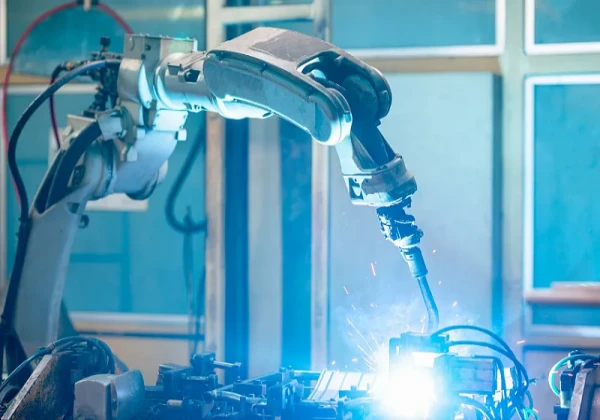
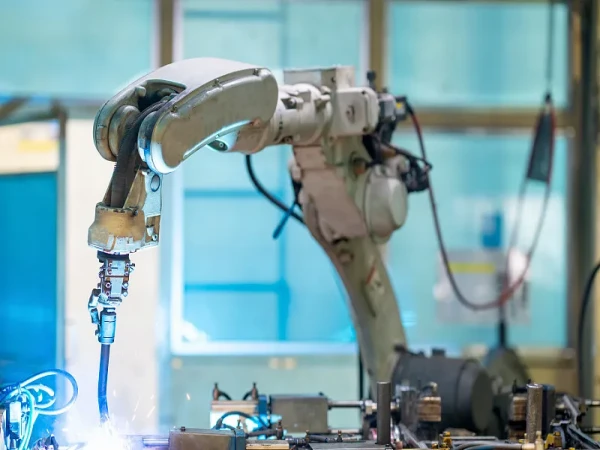
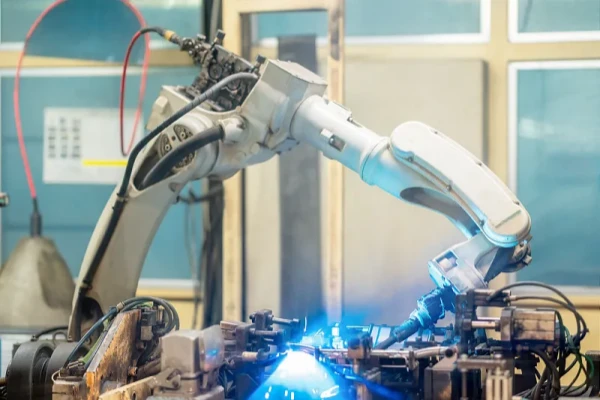
Single Robot Welding Workstation for Smart Automated Welding
GLS single-robot welding workstation does not require complex programming and frequent gun adjustments, and employees can get started in one hour.
It uses high-precision, stable, and safe automated welding to solve the problems of poor welding consistency, high dependence on welders, and high rates of downtime and rework, achieving efficiency improvement, stable delivery, and cost reduction.
Why do companies upgrade single robot welding workstations?
If your business is facing the following problems:
- Shortage of skilled welders
- Labor costs continue to rise
- Welding quality is unstable
- Rework rate remains high
- Workshop space is limited
So the single-robot welding workstation is no longer an optional configuration, but a necessity.
GLS helps you stabilize production output while reducing long-term operating costs.
What is a single robot welding workstation?
The single robot welding workstation is a complete welding unit integrating:
- Six-axis industrial robot
- Digital welding power source
- Intelligent positioner
- safety fence
- Weld seam tracking system
- Centralized control cabinet
Designed for repetitive steel structure welding in batches of 50–5000 pieces.
- Compact footprint: 3m × 3m
- Only 1 operator required
- Supports 2–3 continuous shifts per day
Advantages of Single Robot Welding Workstations
GLS single robot welding workstation built for modern manufacturing
±0.02mm Precision Repeatability, Stable Welding Quality
Precision servo control ensures consistent weld penetration and weld bead formation.
30%–50% Increased Production Efficiency Per Shift
Automated welding improves arc-on time from 30% in manual welding to over 80%.
One equipment can replaces 2–3 skilled welders
Reduce annual labor costs by 40%–60% while maintaining stable welding output.
Support Teach Pendant & Offline Programming
Simple operation without the need for professional robot programming engineers.
Laser Seam Tracking for Irregular Workpieces
Real-time weld path correction maintains precise welding on misaligned parts.
GLS Single Robot Welding Workstation Series
GLS single robot welding workstation built for modern manufacturing
GLS-SW500 single robot welding workstation - standard series
Entry-level robotic welding workstation for structural supports, stiffening plates and simple fillet welds. Equipped with 5KG payload robot, single-axis positioner and MIG welding power source. Supports 1.5mm–20mm carbon steel welding with repeatability of ±0.02mm. Suitable for small processing enterprises with a monthly output of 50–500 pieces.
GLS-SW1000 single robot welding workstation - production series
A mid-range automated welding workstation designed for continuous double-shift production environments. Equipped with a 10KG payload robot, a dual-position positioner and complete MIG/TIG/Arc multi-process functions. Suitable for automobile sub-assemblies, equipment frames and steel structural parts, with a monthly output of 500–3,000 pieces.
GLS-SW2000 single robot welding workstation - precision series
High-specification robotic welding cell specifically designed for stainless steel, aluminum and complex structural applications. Integrated laser welding seam tracking, real-time adaptive thermal control and 3D visual guidance can effectively avoid sheet burnout and deformation, and achieve high-quality welding seams that meet appearance standards and meet standards.
GLS-SW3000 single robot welding workstation - heavy duty manufacturing series
High-load turnkey welding solutions for pressure vessels, column base plates and large steel structural components. It is equipped with a 20KG load robot, a three-axis positioner, an automatic welding gun cleaning unit, and supports full penetration welding of up to 50mm thick steel plates. It is specially built for a three-shift continuous production environment.
Welding Workstation Parameter Specification Table
Know our product specs and select the right GLS welding solution.
| Parameter | Specification |
|---|---|
| Robot Payload | 6–20kg |
| Working Radius | 1400–2000mm |
| Repeat Positioning Accuracy | ±0.02–0.05mm |
| Welding Process | MIG/MAG/TIG |
| Positioner Payload | Up to 1000kg |
| Power Consumption | 30–40KVA |
| Footprint | Approx. 3×3m |
Welding Workstation Parameter Specification Table
Find out advantages of GLS robot welding workstation over traditional manual welding.
| Comparison Item | Manual Welding | GLS Single Robot Welding Workstation |
|---|---|---|
| Effective Arcing Time | 25–40% | 65–80% |
| Defect Rate | 5–8% | <1% |
| Labor Cost | High | Reduced by 40–60% |
| Welding Consistency | Large fluctuation | Fully consistent in every cycle |
| Operating Shifts | 1–2 shifts | 2–3 shifts |
| Return on Investment (ROI) | None | 8–12 months |
Robot Welding Workstation Buying Guide
GLS Robot Welding Workstation operates quickly and arcs stably, and the entire machine complies with ISO 10218-1/2 standards. Equipped with a complete set of safety protection systems, relying on physical safety principles, it can sense personnel entering the working area.
Why is the GLS Single Robot Welding Workstation Different?
Most vendors only sell equipment. GLS, on the other hand, offers an integrated automation system.
✔ Remote technical response within 4 hours
✔ Spare parts shipped within 48 hours
✔ On-site service provided within 72 hours
✔ 2-year warranty
✔ Professional automation integration capabilities
✔Digital production monitoring function
We are more than just a robot supplier – we are automation solutions engineers.
Customer Testimonials
Reviews from our global partners
Applications of Single Robot Welding Workstations
GLS single robot welding workstation is suitable for batch welding in multiple industries, with high efficiency, stability and controllable quality.
Applicable workpieces: gusset plates, brackets, base plates, etc.
Steel structure manufacturing
Applicable workpieces: gusset plates, brackets, base plates, etc. The GLS single robot welding workstation is an efficient production tool for steel structure factories. Whether it is components under EN 1090 or AWS D1.1 standards, we can handle them stably and easily pass UT non-destructive testing, greatly improving production efficiency and qualification rate.
Applicable workpieces: motor base, pump unit base, safety guardrail, maintenance platform, etc.
General industrial equipment
GLS workstations are widely used in general industrial fields and are suitable for a variety of repetitive welding scenarios. Whether it’s a pump base in a water treatment plant or a motor mount in a conveyor line, our workstations can help you reduce costs and increase efficiency.
Applicable workpieces: seat frames, exhaust brackets, chassis beams, etc.
Auto parts manufacturing
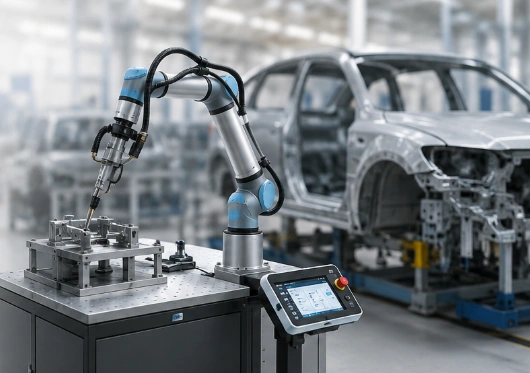
Vehicle body welding is mostly a multi-robot collaboration scenario, while the GLS workstation is more focused on high-volume automotive sub-assembly welding, fully meeting the traceability and quality requirements of automotive Tier 1/Tier 2 suppliers.
Applicable workpieces: machine tool frames, traction brackets, PTO shields, loader arms, etc.
Agricultural Equipment
Agricultural machinery has been subjected to vibration, impact load and corrosive environment for a long time, and the welding quality directly determines the life of the equipment. The GLS workstation solves the pain points of traditional manual welding with unstable quality and easy weld cracking in the field, ensuring the reliability of agricultural equipment under harsh working conditions.
Frequently Asked Questions
A single robot workstation is a self-contained automation cell built around one robot arm. It handles one task — such as palletizing, welding, or machine tending — in a compact footprint designed for standalone operation.
It can palletize cartons and bags, tend CNC machines, perform arc or spot welding, or assemble parts. A single robot station is ideal for repetitive tasks in small-to-mid-size production lines.
Depending on the robot type. If you deploy a collaborative robot in the workstation, 10-level collision detection allows fencing-free operation. For standard industrial arms, safety light curtains or fencing are required.
A collaborative single robot workstation can be installed and running in 4 to 8 hours. Industrial versions typically require 1 to 3 days for mounting, wiring, and programming.
Yes. Most single robot stations support future upgrades — adding a second robot for dual-arm cells, integrating conveyors, or connecting to a plant-wide MES system. Start small, scale up.
Get a free quote →
Ready to deploy your collaborative robot?
Just submit the workpiece drawings and production requirements, and our engineering department will tailor-make your collaborative robot solution, quickly match the production line, and provide an accurate quotation within 48 hours.