GLS –Welding Robot Manufacturer
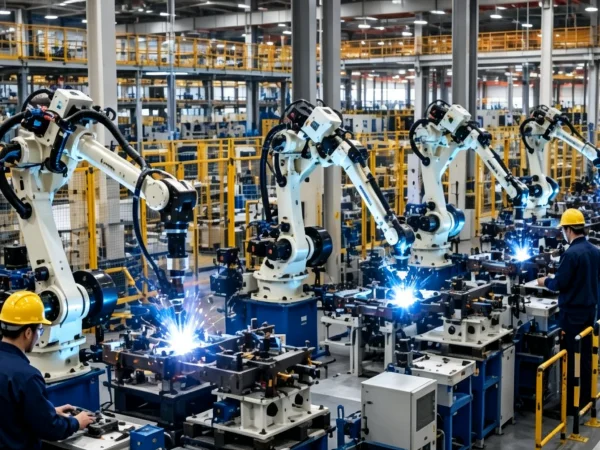
Welding robot solutions help manufacturing companies upgrade efficiently
Welding efficiency increased by 30%-50%
Weld consistency reaches ±0.02mm
24-hour continuous and stable operation
6-12 months investment payback period
What problems are welding robots solving?
GLS welding robots solve your factory’s manual welding pain points, boosting efficiency, cutting errors and stabilizing production for manufacturers.
01
Welders are difficult to recruit and labor costs are high
02
Welding quality is unstable and products are unqualified
03
Low continuous operation efficiency and high rework rate
04
High temperature and high-risk environment affects safety
05
Orders grow but production capacity is limited
How do welding robots change the status quo?
The welding robot achieves continuous high-quality welding operations through automatic path control, intelligent arc swing system and stable current output. You no longer rely on skilled welders to achieve consistent weld results.
GLS Welding Robot Core Advantages
GLS provides 4 welding robots featuring ±0.02mm precision, intelligent weaving, flexible deployment & human‑robot collaboration for stable, efficient welding production.
High Precision Welding Robot System
- Repeat positioning accuracy ± 0.02 mm
- Uniform and beautiful weld formation
- Automatic trajectory planning
Intelligent arc welding robot
- Supports sine/zigzag/ellipse/crescent arcs
- Automatically generate welding procedures
- Multi-track teaching function
Flexible Deployment Welding Robot
- Magnetic base design for easy mounting
- Suitable for a variety of workstations
- Rapid deployment and flexible production transition
Collaborative Welding Robot
- Support for human-robot collaboration
- Multi-Level Security
- Features compact footprint to save factory space
GLS Welding Robot Core Functions
GLS Welding Robots offer high‑precision welding, multi‑process support and intelligent functions to boost your factory production efficiency and weld quality.
Precision welds, every lane is perfect
± 0.02 mm path accuracy, completely eliminating air holes and bite defects.
One robot to replace two welders
24/7 continuous operation, no fatigue, no need to rest, completely eliminate welding differences between shifts.
Multiple processes, all in one
MIG, TIG and various arc welding robot modes can be supported without replacing the hardware.
Four swing modes for complex joints
Sine, sawtooth, elliptical, and crescent swing modes for flexible adaptation to any joint geometry.
One-click generation of JBI files
Instantly save, invoke, and transfer welding procedures across devices.
Is inconsistent welding quality causing you to lose customers and orders?
Core accuracy and defect control
GLS welding robots are designed to eliminate all variables that cause defects – including welding gun angle, travel speed, heat input and arc stability, ensuring stable welding quality from the root.
Human-machine collaboration and spatial advantages
As a true collaborative welding robot, it can work safely alongside your team without the need for safety fences, reducing your site footprint by up to 40%. Our robotic welding systems support MIG, TIG and various arc welding robot configurations on the same platform.
Production adaptation and comprehensive benefits
Whether you are engaged in “multi‑variety, small‑batch” flexible production or continuous large‑scale production, the GLS welding automation system can perfectly fit your workflow — compared to manual operation, it delivers perfect welding results at a faster speed, lower cost and higher reliability.
Application of Welding Robot
GLS Welding Robots offer high‑precision welding, multi‑process support and intelligent functions to boost your factory production efficiency and weld quality.
Steel structure and heavy component processing
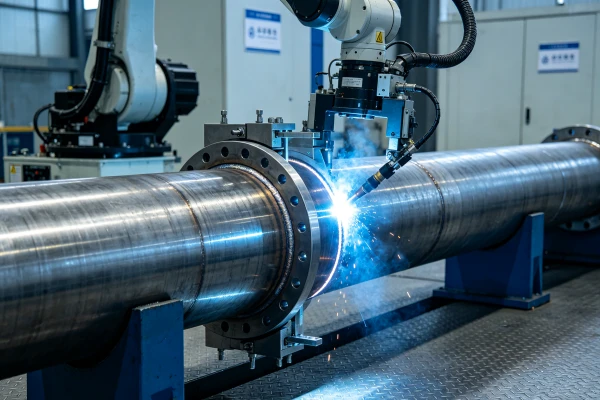
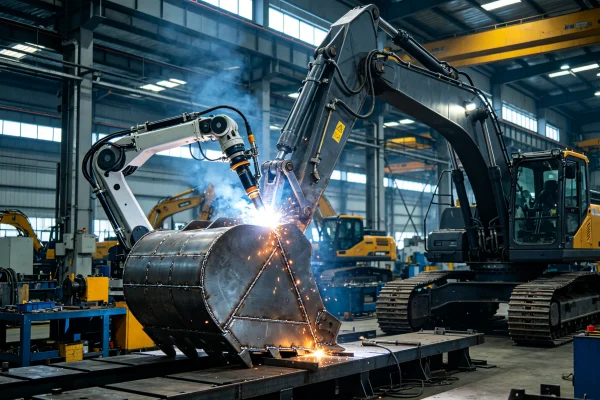
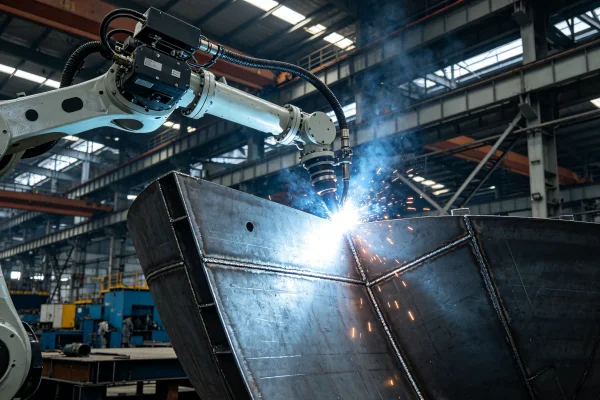
Welding of heavy steel structures requires long-distance continuous welding to ensure stable penetration. The GLS arc welding robot can maintain a stable arc on steel beams, columns, and plate components. The welds can be formed in one go to comply with AWS and ISO standards, avoiding non-destructive testing failures and rework losses, and ensuring project profits.
Welding of automobile parts and chassis parts
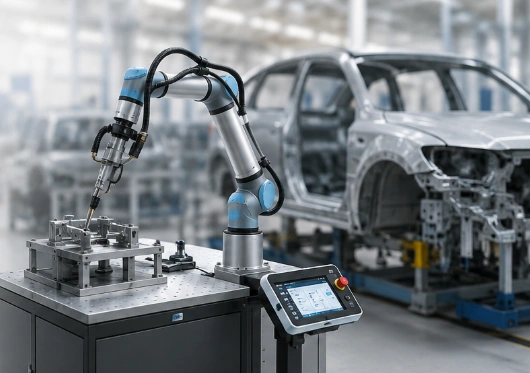
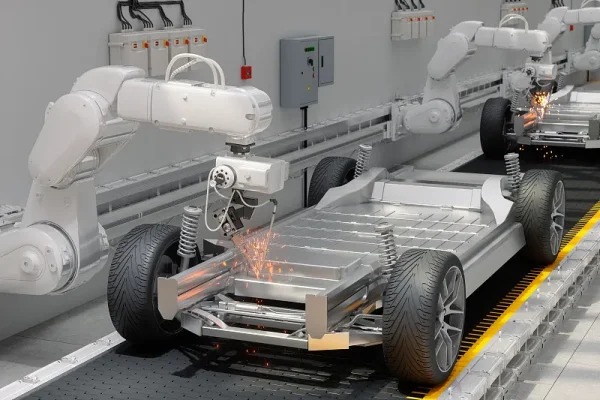
Automotive parts welding requires high-volume, high-precision, repetitive operations. The GLS welding robot has a repeatable positioning accuracy of ±0.02mm and can stably reproduce the welding trajectory; it can be connected to the stamping production line without changing the production line layout, helping to pass the quality audit of the OEM and alleviating the production bottleneck caused by the shortage of professional welders.
Stainless steel & aluminum precision welding
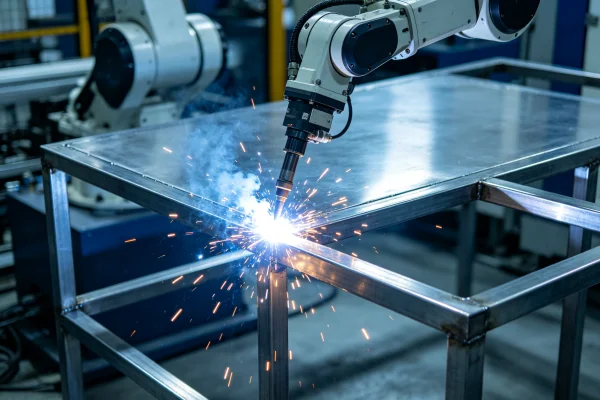
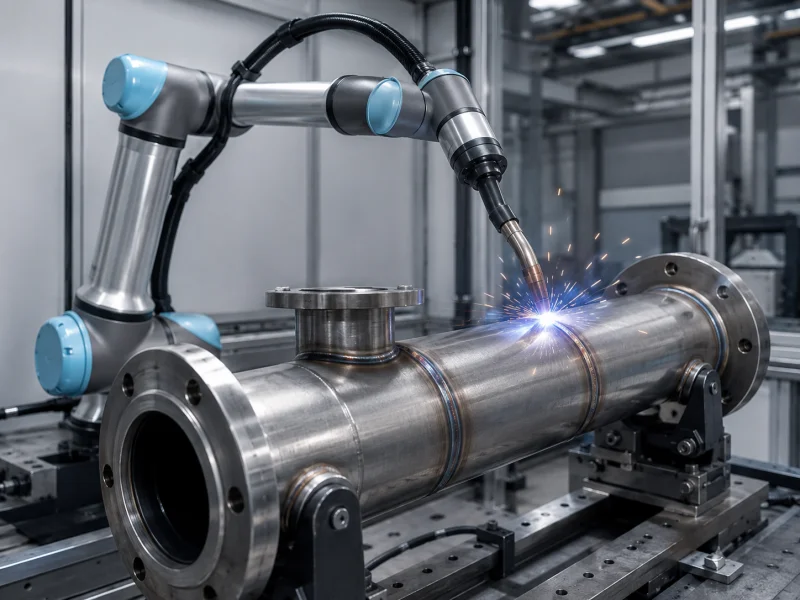
Thin-walled stainless steel and aluminum materials are prone to deformation, burn-through, and discoloration due to uneven heat input. The GLS argon arc welding robot monitors and automatically adjusts arc parameters in real time and strictly controls heat input. It is suitable for food equipment, pharmaceutical containers, and decorative hardware to create high-end welds that are compliant and beautiful.
Metal furniture and daily necessities
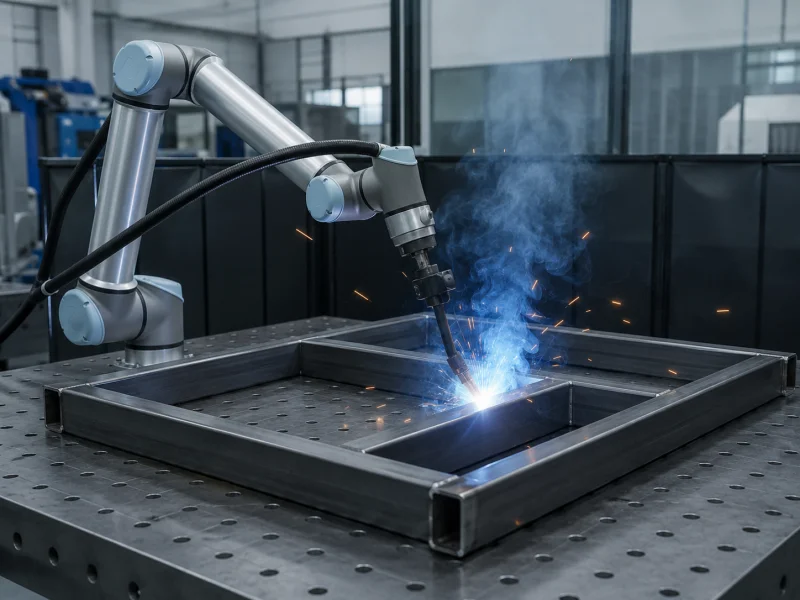
Multi-category, small-batch furniture welding is difficult to automate. The GLS collaborative welding robot only takes 4 hours to change models. It is easy to use through drag-and-drop teaching. Workpieces such as chair frames and brackets can be switched in a single shift, unifying the appearance of product welds and eliminating the high single-piece programming costs of traditional automation.
GLS Welding Robot Technology Highlights
GLS currently has 6 professional sales elites and after-sales specialists, as well as its own engineer and technical team.
03 – Workstation for Collaborative Robot and Pipe Bending Machine Loading/Unloading
Intelligent welding track system
Automatically identify welding paths and improve production rhythm.
Real-time current and voltage control system
Ensure stable welding output and effectively reduce spatter rate.
Multi-station linkage system
Enable multiple welding devices to safely work together seamlessly.
Quality Control and Flexible Deployment
Our collaborative robots are equipped with intelligent force control technology, which greatly reduces product defect rates, is flexible and quick to deploy, and efficiently adapts to the diversified production needs of the electronics industry.
Welding Robot Investment Return Analysis
- Labor costs reduced by 40%-60%
- Rework rate reduced by 50%
- Increase production capacity by more than 30%
- Payback period 6-12 months
- Welding robots help you build an intelligent manufacturing system with sustainable growth.
| Welding Robot vs Manual Welding Comparison Table | ||
| Comparison Dimension | Welding Robot | Manual Welding |
| Efficiency | High | Affected by operator status |
| Stability | Highly consistent welding results | Welding quality fluctuates greatly |
| Cost | Lower long-term operating cost | Labor cost continues to rise |
| Safety | High operation safety, no personal injury risk | There are safety risks in welding operation |
GLS Welding robot parameter comparison table
GLS collaborative robot is a high-precision, high-flexibility and high-efficiency solution for industrial automation.
| Parameter | GLS Mobile Cobot Welder | GLS Fixed Welding Robot | GLS Precision TIG Robot | GLS Multi-Station Cell |
| Welding Process | MIG / Arc | MIG / Arc / TIG | TIG / Micro-TIG | MIG + TIG Dual |
| Payload Capacity | 5 KG | 10 KG | 5 KG | 10 KG × 2 |
| Working Radius | 920 mm | 1,350 mm | 920 mm | 1,800 mm |
| Path Repeatability | ±0.02 mm | ±0.03 mm | ±0.02 mm | ±0.02 mm |
| Swing Pattern Modes | 4 Modes | 4 Modes | 4 Modes | 4 Modes |
| Teaching Method | Drag-to-Teach | Drag + Offline | Drag-to-Teach | Offline Programming |
| Setup Time | 4 Hours | 1 Day | 4 Hours | 3–5 Days |
| Safety Cage Required | No | Optional | No | Optional |
| Avg. ROI Period | 6–8 Months | 8–10 Months | 7–9 Months | 10–14 Months |
| Best Application | Job shops, flexible lines | Automotive, heavy fab | Stainless, aluminum | High-volume, multi-process lines |
Get a free quote →
Ready to deploy your collaborative robot?
Just submit the workpiece drawings and production requirements, and our engineering department will tailor-make your collaborative robot solution, quickly match the production line, and provide an accurate quotation within 48 hours.
Customer Reviews
Sincere feedback and authentic evaluations from our trusted cooperative partners.
After-Sales Service and Technical Support
GLS has established a hierarchical response service system, relying on the three-in-one service of remote diagnosis, spare parts guarantee, and on-site support to quickly resume production line operation and minimize downtime.
6-hour remote rapid response:
VPN remote diagnosis, quickly solve software, parameters, trajectory abnormalities and other faults, and quickly resume production
48-hour global spare parts guarantee:
Adequate inventory of consumables, global logistics and distribution, avoiding downtime due to shortage of consumables
72-hour on-site service:
Complex fault engineer on-site, complete maintenance and calibration on the same day in China/as contracted
Full installation and commissioning delivery:
engineers follow up on installation, parameter debugging, trial production verification to ensure stable production
Systematic operation and maintenance training:
Training operation, maintenance, troubleshooting, offline programming to achieve independent operation and maintenance
Improve the quality assurance and maintenance system:
2-year warranty for core components, 1-year warranty for wearing parts, providing extended warranty and annual maintenance services
GLS Welding Robot — Full System Price Guide
| System Type | Price Range (USD) | Key Cost Driver | Best For | Avg. ROI Period |
| GLS Collaborative Welding Robot (Cobot) | $10,000–$20,000 | Welding power source & process type (MIG/TIG/Arc) | Job shops, SMEs, flexible low-volume mixed-part lines | 6–8 Months |
| GLS Intelligent Welding Workstation | $20,000–$30,000 | Positioner configuration & automatic loading system | Mid-volume structural components, repeat-geometry parts | 8–10 Months |
| GLS Rail-Mounted Welding System | $32,000–$58,000 | Rail length (2m–12m) & seam tracking package | Long-seam welding, beams, pipe sections, pressure vessels | 10–14 Months |
| GLS Cantilever Welding System | $40,000–$55,000 | 3D vision integration & torch cleaning unit | Precision fabrication, complex joint geometry, stainless | 10–14 Months |
| GLS Gantry Welding System (Dual Robot) | $68,000–$80,000 | Portal span, point cloud software & dual-robot sync | Heavy fabrication, shipbuilding, large structural assemblies | 12–18 Months |
Get a free quote →
Get a quote for a custom welding robot
- Since every welding project is unique, in order to obtain an accurate quote estimate, please provide the following information:
- Workpiece drawings or dimensions/Material type and thickness/Type of welding required (MIG, TIG, laser, etc.)/Monthly output/Target budget or expected return on investment
- Our engineers will respond within 24 hours.
Frequently Asked Questions
What is a collaborative robot?
Collaborative robots are industrial robots used to interact directly with human workers. They do not require safety fences and rely on sensors and force control technology to ensure human-machine safety
What is the difference between collaborative robots and industrial robots?
Industrial robots need to be fenced for isolation operations; collaborative robots have built-in safety sensors and can directly collaborate with people at close range.
In what fields are collaborative robots mainly used?
It is mostly used for welding, assembly, loading and unloading, palletizing, inspection, transportation, etc., and is suitable for small batch and multi-frequency production change scenarios.
Is it safe to work with collaborative robots?
It is safe and comes with force limiting, collision detection and other protections; a compliance risk assessment needs to be completed before deployment.
How much do collaborative robots cost?
The mainstream price is US$15,000-25,000, which is affected by load, arm span, and function; it also includes additional costs such as fixtures and integration.
What is the typical payload capacity of a collaborative robot?
Our collaborative robots have a payload range of 2–50kg
Is it easy to program collaborative robots?
The operation is simple and supports drag-and-drop teaching and visual programming. Novices can get started with simple training in 1 to 2 hours.
Which industries have the most extensive use of collaborative robots?
Electronics, automobiles, metal processing, medical, food packaging, etc., suitable for highly flexible automation scenarios.
How long does it typically take to deploy a cobot?
Basic application can be completed in 1 to 3 days, depending on fixture, site layout and safety verification requirements.
What advantages do collaborative robots have for small manufacturers?
It has low investment, small area, easy integration, flexible production change, and does not require large-scale transformation of existing production lines.