Application of collaborative robots in automotive manufacturing
Create more flexible and efficient welding automation solutions for automotive parts companies
GLS Flexible Collaborative Robot
Helps you automate flexible welding upgrades for higher productivity and more stable welding quality with less effort.
- ± 0.02 mm repeatability
- 20% -30% improvement in welding efficiency
- Deployment of standard station within 1 day
- 6-10 month payback period
300 +
Robot Integration Project Experience
20% -30%
Improved welding efficiency
6-10 months
Average payback period
24 hours
Technical Support Response
🥇 AAA grade credit enterprise
👥 Robotics Association Member
🔒 Support for signing NDAs Compatible with
🔌 all brands of mainstream welding machines
Flexible Manufacturing Capability
- NEV orders tend to be small batches and multi-category, and traditional production lines are troublesome to change
- The collaborative robot drags and teaches, and the model change is fast and has strong flexible production capacity
- Suitable for machining chassis parts, sub-frame, battery tray, commercial vehicle structural parts.
Stable and consistent welding quality
- The quality of manual welding is unstable and fluctuates greatly
- The robot is equipped with visual weld tracking to automatically correct the weld path, and the weld is uniform and uniform
- Fewer welding defects, fewer reworks and higher yields.
Achieve a faster return on investment
- Collaborative robots are easy to deploy, have low investment thresholds, and have no pressure to upgrade automation
- Provide labor, improve efficiency, and reduce rework. Automobile welding projects can be repaid in 6–10 months.
Product Configuration Scheme
1. Visual Weld Tracking System
Advantages: Auto correct workpiece deviations, boost welding precision, cut manual operation
Scenarios: Chassis, frame & battery tray welding
2. Fast Deployment System
Core strengths: Plug-and-play, quick installation & commissioning.
Fast mass production launch; standard workstations ready within 1 day
3. Fenceless Collaborative Layout
Advantages: Save factory space, raise workshop space utilization, match flexible mixed production
Suitable users: SMEs, multi-product mixed lines, flexible manufacturing cells
4. Collaborative Laser Welding Technology
Fit workpieces: EV battery trays, aluminum frames, new energy vehicle structural parts
Customer gains: Smooth, neat welds, low workpiece deformation, consistent product quality
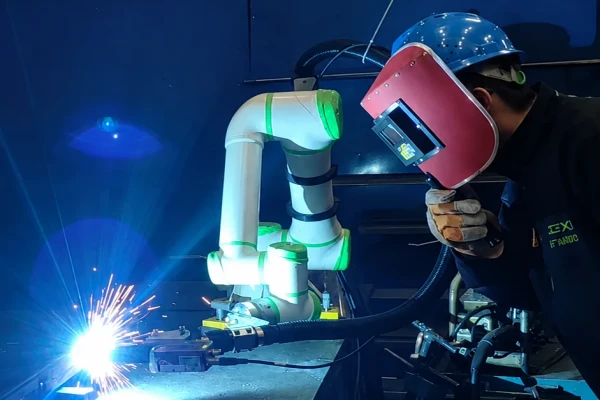
5. Welding Full Data Traceability System
Real-time record items: Welding current, voltage, speed & weld paths
Core value: Meet strict quality standards, enable production data analysis, upgrade quality control management
Product Configuration Scheme
Choose the configuration that suits your production needs
Standard collaborative welding unit
Applies to:
Cradle
Small Structural Components
Features:
Low cost and flexible deployment.
Reinforced Welding Unit
Applies to:
Chassis
Auxiliary frame
Medium and Large Structural Components
Features:
External axis expansion is supported.
Laser Welding Unit
Applies to:
Battery Tray
Aluminum Alloy Structural Parts
Features:
Supports laser welding process.
Table of Technical Parameters
| Parameter | Standard | Enhanced | Laser version |
| Number of robot axes | 6 Axis | 6 Axis | 6 Axis |
| Load capacity | 10kg | 20kg | 20kg |
| Repeat Positioning Accuracy | ± 0.02 mm | ± 0.03 mm | ± 0.03 mm |
| Welding process | MIG/TIG | MIG/Mag | Laser + MIG |
| Weld Tracking | Visual Tracking | Visual Tracking | Laser + Vision |
| Safe Mode | Collaboration | Collaboration | Collaboration |
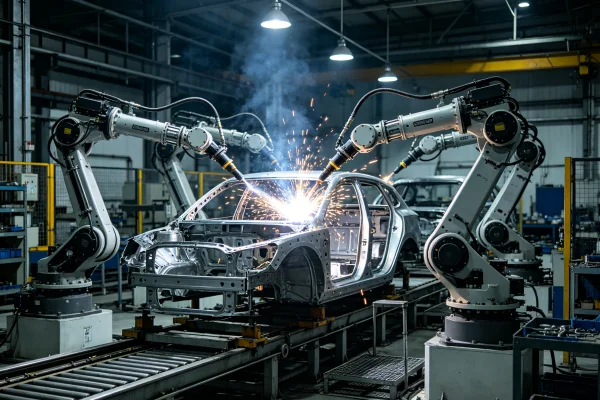
Typical scenarios
✅Automotive chassis welding: Improve weld quality consistency.
✅Subframe welding: reduces the difficulty of manual operation.
✅New energy battery tray welding: meets the needs of lightweight welding.
✅Commercial vehicle structural parts welding: suitable for large workpiece welding scenarios.
Customer Challenges & Solutions
Automatic upgrading of welding production lines
Challenge 1: Welders are getting harder to recruit
- Solution: Reduce reliance on skilled welders with collaborative robots.
Challenge 2: High weld quality fluctuations
- Solution: The visual weld tracking system automatically corrects the weld trajectory
Challenge 3: Frequent product model changes
- Solution: Drag and drop to teach programming for quick type change.
Challenge 4: Automated investments are risky
- Solution: Modular deployment reduces investment pressure and speeds up return on capital.
Industry cases
Our Completed Industry Application Case Studies
Case 1: Automotive chassis manufacturing enterprise
Project Challenges
Manual welding leads to low production efficiency and inconsistent finished product quality.
Custom Solution
Gurath Collaborative Welding Robot System is implemented on the production line.
Measurable Project Outcomes
- Welding production efficiency boosted by 25%
- Product rework rate greatly reduced
- Long-term stable welding quality guaranteed
Case 2: New Energy Vehicle Structural Parts Enterprise
Project Challenges
Severe deformation occurs during aluminum alloy welding.
Solution
Deploy collaborative robot laser welding system.
Project Results
- Markedly upgraded welding surface & overall weld quality
- Effectively controlled and reduced workpiece deformation
- Full traceability of all welding process parameters
Frequently Asked Questions
What automotive manufacturing scenarios are collaborative robots suitable for?
Suitable for welding structural parts such as chassis, subframe, battery tray, exhaust system, frame, etc.
Does it support NEV welding?
Support laser welding, aluminum alloy welding and lightweight structural parts welding
Do you need a professional programming engineer?
Rapid path setup by dragging tutorials without complex programming
How long will the project return to the current cycle?
The return cycle of a typical automotive welding project is 6-10 months.
How do I get an automated program?
All you need to do is upload your product drawings and we will provide you with an automated welding assessment program.

Get a free quote →
Ready to deploy your collaborative robot?
Just submit the workpiece drawings and production requirements, and our engineering department will tailor-make your collaborative robot solution, quickly match the production line, and provide an accurate quotation within 48 hours.