
GLS Material Handling Robot
From unloading and unloading on the production line to warehouse palletizing, the GLS automated material handling system increases your logistics throughput by 40%, saving 2-3 labor per shift, and the fastest investment recovery is 5 months.
Why are material handling robots worth investing in?
Let’s not talk about the product, but first identify the problem.
Hidden costs of manual handling (in China)
Pain point 1: Hidden costs of manual handling (in China)
– Workers’ compensation and medical expenses
– Difficulty in recruiting workers during peak seasons and training costs for temporary workers
– Continuous recruitment expenses caused by turnover rate above 30%
– Night shift allowance and holiday overtime pay
True cost: The comprehensive annual cost of 1 porter is about ¥110,000-¥140,000
Errors in handling
– Wrong placement of parts → processing and scrapping
– Drop damage →difficulty in determining liability
– FIFO (First In First Out) execution is unstable → Inventory management is chaotic
– GLS material handling robot: ±1mm positioning accuracy, 100% execution of preset handling logic
Fixed handling equipment has limited flexibility
– Traditional conveyor line: modification cost ¥50,000+, cycle 2-4 weeks
– GLS material handling robot: Update teaching program and switch to new product line on the same day
Manual handling speed
– One skilled mover: up to 300 handling cycles/hour
– After 6 hours: Speed drops by 18%, error rate increases by 35%
-GLS material handling robot: 1,800 times/hour, the 24th hour is the same as the 1st hour
Material Handling Robot Workflow
The essence of moving is time, and time is money.
01
Visual recognition (0.1 seconds)
3D vision sensor identifies material location, direction and size
Support mixed line production and automatically distinguish different SKUs
02
Path planning (real-time)
AI algorithm plans optimal transportation path in real time
Dynamic obstacle avoidance, automatic deceleration when personnel enter the working area
03
Precise grabbing (±1mm)
The end clamp adjusts gripping force by material characteristics.
Compliance control prevents pinching of precision parts or flexible packaging
04
High-speed transportation
Up to 1,800 cycles/hour consistently
Multi-machine collaboration, linear superposition of production capacity
05
Precise placement + data recording
±1mm consistent placement accuracy
Each transport generates timestamp, location, and weight records Real-time synchronization of MES/WMS systems
GLS Material Handling Robot Product Line
Classified by load capacity
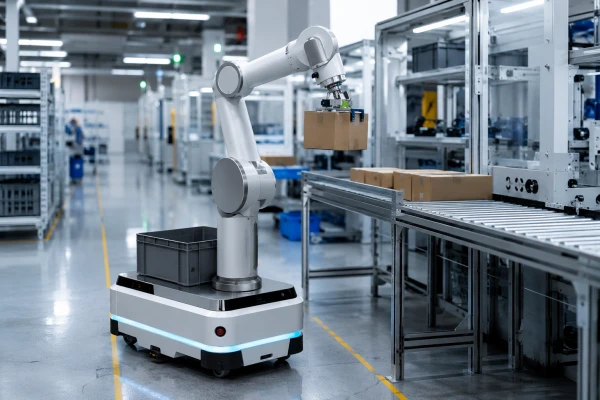
GLS-MH lightweight handling robot (1-10KG)
• Weight reduced by 40% (25kg→15kg)
• Movement speed increased by 30% (max 2.5m/s)
• Energy consumption reduced by 55%
• Service life extended to 50,000 hours
• TÜV certification
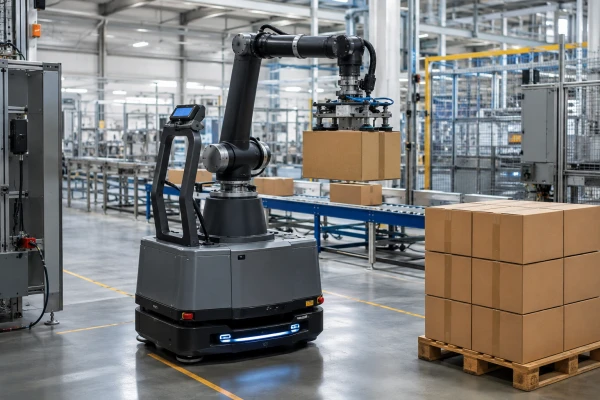
GLS-MH medium-sized handling robot (10-80KG)
• Load: 10-80KG
• Working radius: 1,200-2,100mm
• Cycle frequency: up to 800 times/hour
• Positioning accuracy: ±1mm
• Typical applications: engine block handling, stamping parts transfer, CNC machine tool loading and unloading
Price range: $32,000-$50,000
ROI period: 6-9 months
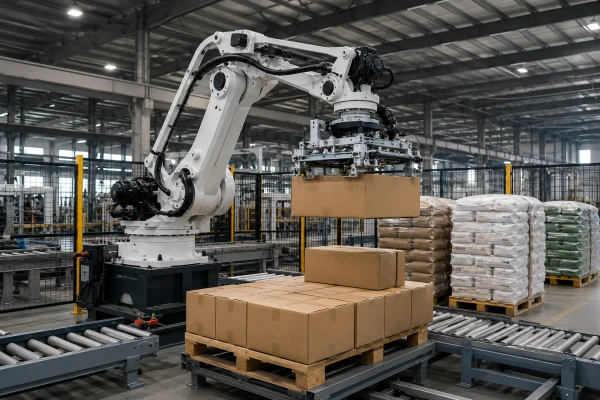
GLS-MH heavy-duty palletizing robot (80-300KG)
• Load: 80-300KG
• Working radius: 2,100-3,200mm
• Palletizing speed: up to 800 packages/hour
• Positioning accuracy: ±2mm
•Support: multiple palletizing patterns, switch with one click
Price range: $52,000-$80,000
ROI period: 7-10 months
8 Key Features of GLS Material Handling Robots
Focus on handling efficiency and scene adaptability, without overlapping with the welding page at all
Multimodal visual recognition system
2D+3D fusion vision can identify scattered, deformed, and reflective materials without the need for fixed tooling, and the recognition success rate is 99.8%.
Modular end clamp quick change
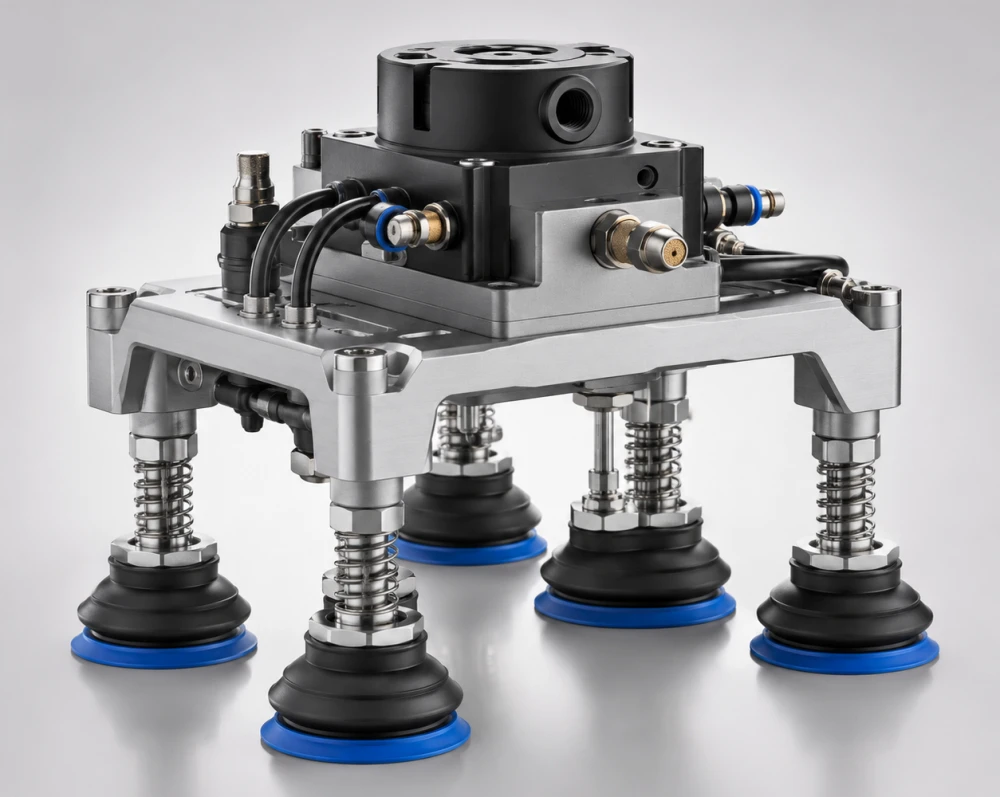
Switching between vacuum suction cups/electromagnetic clamps/flexible grippers/plywood clamps in 5 seconds, one robot covers all your material types.
Soft force-controlled grasping
The end force sensor monitors the gripping force in real time, with 0.1N precision adjustment, and zero damage to precision electronics and soft packaging.
Multi-machine collaboration
The central dispatching system manages multiple handling robots in a unified manner, automatically assigns tasks, eliminates waiting, and linearly superimposes production capacity.
MES/WMS seamless integration
Native support for Modbus TCP/EtherNet IP/PROFINET, each transfer data is written to your management system in real time with zero delay.
Dynamic path planning and obstacle avoidance
Millisecond-level obstacle detection, personnel will automatically decelerate when entering a 3-meter range, and completely stop within a 1-meter range, without the need for safety fences.
Quick change drag teaching
New product launch: Drag the robotic arm to teach a new handling path, which can be completed in 10 minutes without the need for an engineer or reprogramming.
24 hours continuous cold operation
Industrial-grade sealed bearings + automatic lubrication system, MTBF (mean time between failures) ≥ 50,000 hours.
(GLS vs Competing Products vs Manual)
GLS Material Handling Robots beat competing machines and manual handling to optimize your workshop’s overall operational cost.
| Comparison Item | GLS Material Handling Robots | Traditional Fixed Conveyor Lines | Manual Handling |
| Handling Speed | 1,800 cycles per hour | 600–1,200 cycles per hour | 200–300 cycles per hour |
| Product Changeover Time | 10 mins via robot teaching | 2–4 weeks for equipment modification | Instant |
| Applicable Material Types | Unlimited via fixture replacement | Fixed; modification required for new items | Unlimited |
| Positioning Accuracy | ±1 mm | ±5 mm | ±10–30 mm |
| 24/7 Operation | Available with zero extra cost | Available for equipment running | Unavailable; overtime pay & safety risks required |
| Handling Data Traceability | 100% full-cycle recording | Partial data available | No record, manual log only |
| Capacity Expansion | Add new robots instantly | 2–4 weeks of conveyor reconstruction | 3+ months for recruitment & worker training |
| 1st-Year Overall Cost(Single Line) | CNY 280,000–650,000 | CNY 800,000–2,000,000 | CNY 880,000–1,400,000 annually (recurring) |
| 5-Year Total Cost | Lowest | Medium | Highest |
| ROI Payback Period | 5–10 months | 18–36 months | No positive ROI (perpetual ongoing expense) |
Applications of Material Handling Robots
GLS Material Handling Robots beat competing machines and manual handling to optimize your workshop’s overall operational cost.
Food and Beverage – Palletizing and Depalletizing
If you are facing hygiene risks due to frequent manual contact, capacity shortages due to seasonal demand fluctuations, and counting errors that often occur during the palletizing of mixed-size packages.
The GLS heavy-duty palletizing robot is IP65 waterproof and can be cleaned online. It is equipped with 3D vision adaptive multi-specification goods. It can produce up to 800 packages per hour and is in operation around the clock. The palletizing efficiency quadruples, no temporary labor is required during peak seasons, and the defective rate is reduced from 2.3% to 0.02%.
Auto parts manufacturing - automated handling
Due to sharp edges and erratic handling of stamped parts, your plant is experiencing frequent worker injuries, resulting in costly idle press time between shifts.
The GLS material handling robot can achieve synchronous linkage with stamping equipment to achieve fully automatic material transfer; it is equipped with magnetic buffer clamps to effectively avoid workpiece deformation. Your production cycle time is shortened from 45 seconds to 8 seconds, the equipment idle rate is reduced from 18% to 0.3%, and the handling accident rate is reduced to zero.

Electronics manufacturing - parts handling and sorting
Manual transportation of small and high-priced components is prone to electrostatic damage, and errors in the sorting of multi-category products often occur.
The GLS lightweight robot is equipped with anti-static flexible grippers and vision equipment, with a recognition accuracy of 0.1mm, and is linked to MES to prevent mixing; the breakage rate has been reduced from 0.8% to 0.01%, the sorting pass rate is 99.98%, and each production line can streamline 3 to 4 operators.
Warehouse logistics-goods-to-person picking system
Your warehousing labor costs are rising, manual picking is inefficient, it is difficult to temporarily expand production during large sales, and inventory counting errors are high.
The GLS mobile collaborative robot is equipped with AMR navigation and robotic arms to achieve goods-to-person picking, cluster dispatching to cope with burst orders, and automatic synchronization of inventory by docking with WMS; the picking rate has been increased from 80 pieces/hour to 450 pieces/hour, labor usage has been reduced by 65%, and the inventory accuracy rate has increased from 97.2% to 99.97%.
Material Handling Robot Spec Comparison Table
Dimensions such as handling speed, load, cycle frequency, fixture interface, etc.
| Specification | Light-Duty MH | Medium-Duty MH | Heavy-Duty Palletizing MH | Extra Heavy-Duty MH |
|---|---|---|---|---|
| Payload Range | 1–10 KG | 10–80 KG | 80–300 KG | 300–600 KG |
| Working Radius | 600–1,200 mm | 1,200–2,100 mm | 2,100–3,200 mm | 2,500–4,000 mm |
| Repeat Positioning Accuracy | ±0.5 mm | ±1 mm | ±2 mm | ±3 mm |
| Max Cycle Rate | 1,800 cycles/hr | 800 cycles/hr | 800 packs/hr | 200 cycles/hr |
| End Effector Interface | ISO 9283 | ISO 9283 | Custom Flange | Custom Flange |
| Quick Gripper Change Time | 5 sec | 5 sec | 10 sec | 15 sec |
| Ingress Protection | IP54 | IP54 | IP65 | IP65 |
| Operating Temperature | 0°C–50°C | 0°C–50°C | −10°C–55°C | −10°C–55°C |
| MTBF | ≥50,000 hr | ≥50,000 hr | ≥60,000 hr | ≥60,000 hr |
| Power Consumption | 2.5–4 KW | 5–9 KW | 8–14 KW | 15–25 KW |
| Price Range | $18K–$35K | $35K–$68K | $55K–$95K | $85K–$150K |
| ROI Payback Period | 5–7 months | 6–9 months | 7–10 months | 9–14 months |
Industry Case Studies
Comments from domestic customers
Our peak season has been compressed from 6 weeks to 3 weeks, and the number of temporary workers has been reduced from 200 to 60. The GLS palletizing robot operates 24 hours a day, and the pressure of production during peak seasons has basically disappeared. The equipment pays for itself within 7 months, saving an additional ¥4.8 million in labor costs every year. "
— David Chen, Director of Factory Automation, Fujiizumi Beverage
“Last year we had 14 handling-related work-related injuries, with average compensation and downtime losses exceeding ¥80,000 each time. After the GLS handling robot went online, work-related injuries were eliminated, the waiting time for the stamping machine was reduced from 18% to 0.3%, and the production capacity increased by 22%. "
—Sarah Zhang, Dongfeng Motor Supplier Production Director
Quality Control and Flexible Deployment
Our collaborative robots are equipped with intelligent force control technology, which greatly reduces product defect rates, is flexible and quick to deploy, and efficiently adapts to the diversified production needs of the electronics industry.
The first layer: perception layer
• 360° lidar: 8-meter range obstacle detection, 25Hz refresh
• 3D vision: distinguish between people and materials, reducing misjudgment and downtime
• Torque sensor: real-time torque monitoring of each joint, and stop immediately if abnormal
Second layer: response layer
• 3m safety zone: speed reduced to 30% of rated
• 1.5m safety zone: stop after executing the current action
• Emergency contact: complete stop within 50 milliseconds, braking distance <50mm
The third layer: system layer
• Dual channel safety PLC: ISO 13849-1 PLd certified
• Clamp failure detection: abnormal gripping force → perform safe placement procedures immediately
• Power outage protection: Any power supply interruption → Gravity compensation maintains the current posture and prevents heavy objects from falling
Compliance certification:
ISO 10218-1/2:2025 (Industrial robot safety)
ISO/TS 15066 (Collaborative robot safety)
CE Marking (European Machinery Directive)
IEC 60204-1 (Electrical Safety of Machinery and Equipment)
GB 11291 (China Industrial Robot Safety Specifications)
After-sales Service and SLA
The cascading losses of transportation downtime are more severe, so the SLA is stricter
Downtime cascading loss model
The GLS handling system is down for 1 hour:
• Direct loss: material backlog/interruption of supply at this transportation node
• Upstream losses: Feeding equipment is forced to shut down and wait
• Downstream losses: processing equipment has no material available and production capacity returns to zero
SLA commitments and spare parts
SLA commitments and spare parts
• 2 hours remote diagnosis
• Key parts shipped within 12 hours
• 48-hour on-site engineer presence (important industrial cities around the world)
• Fixture Systems: All standard fixture modules available from stock
• Vision system: camera, light source, processor off-the-shelf
• Drive system: servo driver and reducer output shaft are in stock
Frequently Asked Questions
Choose conveyor line or material handling robot?
Large batches of fixed categories → cost-effective conveyor lines; frequent production changes for multiple categories → better material handling robots. Judgment: The annual production change is >12 times, and the ROI of the robot is better than that of the line body; free plan calculation.
What materials are the material handling robots suitable for?
Regular parts are equipped with standard clamping jaws; special-shaped parts are equipped with 3D vision + flexible claws; soft-packed suction cups, metal magnetic suction cups, fragile multi-point suction cups; free clamp design.
Can messy materials be captured?
The material handling robot is equipped with 3D vision to realize bin picking, with ±1mm accuracy and a grabbing rate of 99.2%; material gaps >15mm are available, but strict stacking is not feasible; samples can be sent for free actual testing.
How to connect MES/WMS?
Compatible with OPC‑UA, Modbus and other protocols + REST API; upload data such as working hours/weight, standard docking takes 1 to 3 days, and free technical docking.
How to ensure human and machine safety?
Three-stage protection: 3m speed reduction, 1.5m stop, 0.5m touch stop; complies with ISO10218, and customers’ work-related injuries will be cleared after landing.
How Much Cost Can Your Factory Save With Material Handling Robots?
Calculate your actual cost savings by replacing manual handling with our material handling robots. See annual labor loss, part damage waste & payback cycle based on your production data.

Get a free quote →
Get a quote for a custom welding robot
- Since every welding project is unique, in order to obtain an accurate quote estimate, please provide the following information:
- Workpiece drawings or dimensions/Material type and thickness/Type of welding required (MIG, TIG, laser, etc.)/Monthly output/Target budget or expected return on investment
- Our engineers will respond within 24 hours.