Collaborative Palletizing Robot – Smart, Safe, and Affordable
Empower your production line with a lightweight cobot palletizer — zero coding, 4-hour deployment
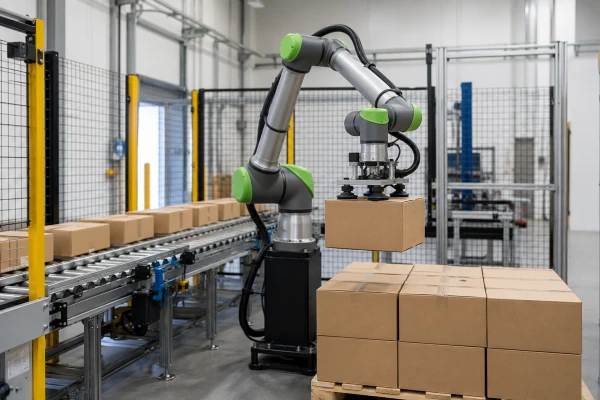
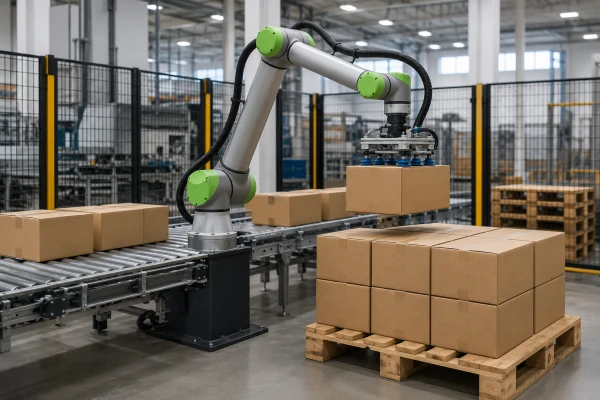
GLS collaborative palletizing robot
Really suitable for small and medium-sized manufacturing enterprises
- Beginner-friendly: 30 min to program, 4 hours to master
- 10-level collision detection for safe human-robot collaboration
- Compact design fits any existing production line instantly
- ROI within 6–10 months — lower cost than traditional industrial palletizers
Why Choose GLS Palletizing Robot
A palletizing robot designed for your real-world constraints—not a textbook standard factory
30 minutes to master
Zero threshold programming 30 minutes of visual programming – no robotics background required. Your existing operators will be up and running on day one.
50ms emergency stop
Human-machine safety integration 10-level collision detection system – the robot stops immediately when it comes into contact with the human body. No safety fences or ground modifications are required.
3-5 days delivery
Extremely fast deployment Integrated workstation design – all installation and commissioning of the palletizing robot can be completed within 3-5 days instead of 6-12 weeks.
±5mm accuracy
Stable stacking to prevent collapse The layer-by-layer palletizing accuracy is within ±5mm – completely eliminating pallet collapse and cargo damage claims during transportation.
30 seconds changeover
Flexible switching of multiple SKUs 50+ palletizing patterns for product variations, switching can be completed within 30 seconds on the touch screen. No engineers required, no downtime.
Payback in 6-10 months
Proven return on investment The average investment recovery is 6-10 months, verified by 100+ customer deployments – while traditional industrial palletizing systems take 18-36 months.
Introduction to GLS Palletizing Robot
Our collaborative palletizing robots are designed for small and medium-sized manufacturers looking for an affordable and easy-to-use automation solution.
The robot has a lightweight body, intuitive “drag and teach” programming function and a ten-level collision detection system, and can be seamlessly integrated into various production lines.
Whether it is handling cartons, bags or barrels, this palletizing robot can effectively reduce manual labor, improve production efficiency, and achieve a return on investment of less than one year.
GLS Palletizing Robot Product Line
The single robot welding workstation is a complete welding unit integrating:
- Six-axis industrial robot
- Digital welding power source
- Intelligent positioner
- safety fence
- Weld seam tracking system
- Centralized control cabinet
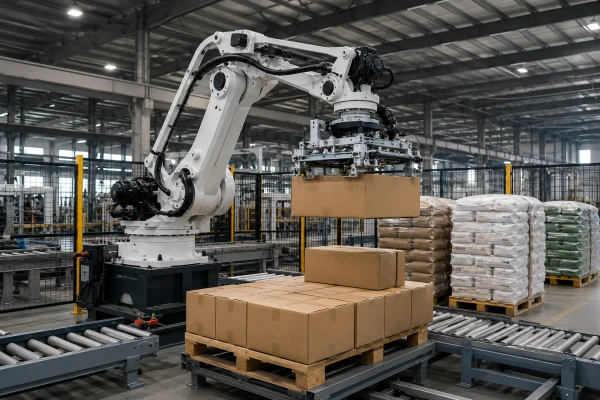
Multi-operation palletizing robot – extended operating range and payload, suitable for multi-variety production. Supports single-machine and multi-machine collaborative operation.
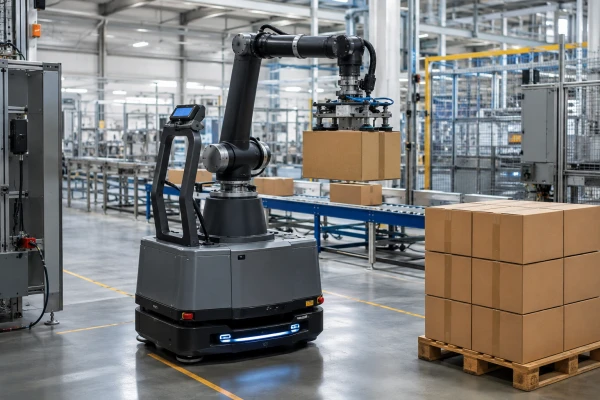
Custom Palletizing Systems – End effectors, software and conveyor integration customized for factory-specific palletizing workflows.
Manual Palletizing VS Palletizing Robots
Most small and medium-sized manufacturing companies underestimate the true cost of manual palletizing – the basic salary is visible, and the rest are hidden expenses.
Manual Palletizing Cost Breakdown
| Cost Item | Annual Amount (USD) |
|---|---|
| Basic Salary (3 Workers × 3 Shifts) | 35,000.00 |
| Social Insurance & Employee Benefits (30% Accrual) | 10,500.00 |
| Peak Season Temporary Labor Cost | 6,666.67 |
| Work Injury Insurance & Accident Compensation | 5,000.00 |
| Palletizing Errors & Cargo Damage Claims | 4,583.33 |
| Night Shift & Holiday Overtime Allowance | 5,333.33 |
| Recruitment & Retraining Cost (30% Turnover Rate) | 4,000.00 |
| Total Annual True Cost | 71,083.33 |
Robot Palletizing Operating Cost
| Cost Item | Annual Amount (USD) |
|---|---|
| Equipment Depreciation (8-Year Amortization) | 6,250.00 |
| Salary for 1 Full-Shift Operator | 10,000.00 |
| Annual Maintenance Contract Fee | 2,361.11 |
| Equipment Consumables Cost | 1,166.67 |
| Total Annual Cost | 19,777.78 |
- Annual Cost Savings USD 51,305.56
- Investment Payback Period 6–8 Months
- Cost Reduction Ratio 72%
Industry Applications for GLS Palletizing Robots
Custom GLS palletizing robot solutions for 3C, food, metallurgy & auto sectors, cutting manual labor & palletizing error for your production line.
Electronic 3C industry
High-speed palletizing of precision small packages eliminates the need for temporary workers during peak seasons. The GLS collaborative palletizing robot supports high-speed palletizing of precision small packages within 10 kg. The visual positioning system automatically identifies different SKU packaging specifications and switches palletizing patterns in 30 seconds.
We have provided end-of-line palletizing automation solutions to electronic 3C companies such as Luxshare Precision and Galaxy Electronics. The demand for temporary labor during peak seasons has been reduced by more than 60%, and the palletizing error rate has dropped from 3.2% to 0.05%.
Food and Beverage Industry
IP65 sanitary grade palletizing, 24 hours non-stop at full load. GLS-PL-M standard palletizing robot is equipped with IP65 protection level, supports cleaning operation environment, and the end clamp is made of food-grade material.
The 3D vision system automatically identifies different SKUs such as bottles, bags, boxes, etc., switches the palletizing pattern with one click, and can continuously output up to 900 packages/hour. There is no need to send additional manpower during peak seasons, so that the end of your food production line can truly achieve the same set of equipment during off-peak and peak seasons.
Iron and steel metallurgical industry
Heavy-duty palletizing replaces labor and eliminates safety accidents at the end. The GLS-PL-H heavy-duty palletizing robot has a payload coverage of up to 600 kg. Cooperation with leading steel companies such as Shagang Group and Yonggang Group has verified its reliability in heavy industrial environments.
It has a built-in overload protection and torque monitoring system, the end clamp is specially designed for steel packaging, and the IP65 protection level can cope with dust and moisture conditions, reducing over 90% of work-related injuries related to heavy-duty palletizing on average every year.
Auto parts
Multi-SKU mixed line palletizing reduces production change time from 4 hours to 30 minutes. The GLS palletizing solution we provide to automotive customers such as Jatco supports mixed-line palletizing of 50+ parts packaging specifications, and the production changeover time is reduced from 4 hours in the traditional solution to less than 30 minutes.
Each pallet automatically generates batch traceability records to meet the OEM’s strict audit requirements for supply chain traceability.
4 Core Functions of GLS Palletizing Robots
GLS single robot welding workstation built for modern manufacturing
Collision Detection
10-level intelligent sensing stops instantly on contact. Safe for human-robot collaboration.
Drag-and-Teach
No coding needed. Guide the arm to record positions and paths in minutes.
Compact Footprint
Integrated body fits tight factory spaces. No major layout changes required.
Flexible Gripper
Interchangeable tooling handles cartons, bags, drums, and irregular objects.
Safety Response Area Diagram
- 3-meter warning zone – automatically slows down to 30% of rated speed
- 1.5m stop zone – stop immediately after completing the current action
- Direct contact – complete stop within 50 milliseconds
- ✅ 100+ customer deployments · Zero work injury record
ISO 10218-2:2025
Industrial robot safety
ISO/TS 15066
Collaborative robot safety requirements
CE certification
European Machinery Directive 2006/42/EC
IEC 60204-1:2018
Electrical safety of machinery and equipment
ISO 9001:2015
Quality management system
Quality Control and Flexible Deployment
Our collaborative robots are equipped with intelligent force control technology, which greatly reduces product defect rates, is flexible and quick to deploy, and efficiently adapts to the diversified production needs of the electronics industry.
Intelligent force control technology reduces defective product rate by 40%
There is no room for error in the electronic production process, and the GLS force-controlled collaborative robot can monitor and autonomously adjust end-end work intensity in real time.
Whether it is terminal pressing, locking screws or circuit board insertion, the force is uniform and uniform throughout the process, and the operation is stable and standardized.
After being put into use by many cooperative customers, the defective product rate can be reduced by 40% in the first month, completely reducing rework losses and significantly increasing production profits.
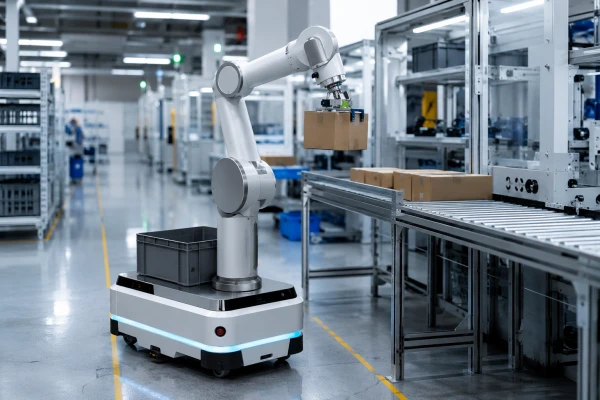
Flexible and easy to move, complete production line switching in a single day
Nowadays, products in the electronics industry are iterating rapidly, and fixed automation equipment has long been unable to keep up with the production pace.
This lightweight collaborative robot weighs as little as 11 kilograms and is equipped with a magnetic base. It can be quickly moved and deployed in the factory, and the workstation can be relocated within a few hours.
Products can be quickly switched without complex reprogramming, significantly reducing setup times and simplifying production adjustments. This not only enables fast delivery of orders, but also improves the overall operational efficiency of the production line.
Palletizing Robot Maintenance Guide
Maintenance plans are simple, regularized, and can be put directly into the factory’s standard work instructions.
| Cycle | Task Content | Time Required |
|---|---|---|
| Daily | Clean the contact surface of the end-of-arm tooling (EOAT) | 3-5 minutes |
| Daily | Check the status and suction pressure of vacuum suction cups | 2 minutes |
| Daily | Check the vision system lens for dust and condensed water | 1 minute |
| Daily | Verify the accuracy of the palletizing pattern for the first 3 pallets | 5 minutes |
| Weekly | Check the cable routing along the robot arm | 10 minutes |
| Weekly | Clean the conveyor interface and sensor surface | 10 minutes |
| Monthly | Calibrate TCP (Tool Center Point) | 20 minutes |
| Monthly | Test all safety devices | 15 minutes |
| Monthly | Inspect gripper wear parts | 20 minutes |
| Quarterly | Lubricate all robot axis joints (Axis 1-6) | 45 minutes |
| Quarterly | Inspect the backlash of each axis reducer | 30 minutes |
| Annually | Full-axis kinematic calibration | 2-3 hours |
| Annually | Safety system audit – ISO 10218-2 | 2 hours |
| Annually | Controller firmware update | 1 hour |
| Annually | Full inspection and wear measurement of the end-of-arm tooling (EOAT) | 1 hour |
Maintenance's Most Common Mistakes
- Neglecting vacuum cup inspection is the most common problem. A suction cup with a 15% drop in suction power will not trigger an alarm immediately, but will bring the pallet collapse rate back to close to artificial levels within 3 weeks.
- Replace the suction cup every 6 months under standard conditions and every 3 months in high temperature or oily environments.
Customer Reviews
Real feedback and reviews from our partners.
Frequently Asked Questions
Is the GLS palletizing robot suitable for small factories with small daily output?
Suitable, and GLS-PL is specially designed for this type of application scenario. The economic accounting of automation does not rely on high output, but on whether current labor costs exceed the amortized cost of equipment. If you are not sure whether your output supports automation, GLS provides free production line assessment and ROI calculation services.
Can you really learn how to operate it in 30 minutes?
Yes. The drag-and-drop visual programming interface is designed for production operators with no technical background. The first complete programming of a standard palletizing pattern usually only takes 8-12 minutes, with 30 minutes including pattern verification and first production run.
When package size changes, do I need to reprogram?
It usually only takes 10-30 minutes to bring a new product online, without the need for external engineers. The operator selects a new pattern on the touch screen and enters the dimensions, and the system automatically generates the palletizing pattern. Repeat orders can be retrieved within 30 seconds.
What product types and packaging formats can GLS handle?
It can handle corrugated boxes, bagged products, bottled products, plastic turnover boxes and pallets, barrels and multi-SKU mixed pallets. The end clamp can be equipped with vacuum suction cups, mechanical clamps or custom composite tools depending on the product form.
Space is extremely limited, does GLS have a solution?
Yes. The GLS-PL collaborative palletizing workstation occupies an area of about 8 square meters and can be placed directly at the end of the existing production line without the use of safety fences. For extreme spaces, the engineering team provides a layout optimization assessment.
What is the typical payload capacity of a collaborative robot?
Our collaborative robots have a payload range of 2–50kg
Is it easy to program collaborative robots?
The operation is simple and supports drag-and-drop teaching and visual programming. Novices can get started with simple training in 1 to 2 hours.
Which industries have the most extensive use of collaborative robots?
Electronics, automobiles, metal processing, medical, food packaging, etc., suitable for highly flexible automation scenarios.
How long does it typically take to deploy a cobot?
Basic application can be completed in 1 to 3 days, depending on fixture, site layout and safety verification requirements.
What advantages do collaborative robots have for small manufacturers?
It has low investment, small area, easy integration, flexible production change, and does not require large-scale transformation of existing production lines.
Get a free quote →
Start now and let GLS do an evaluation using your actual production line data.
If you are concerned about deployment cycle, changeover efficiency, investment recovery and safety compliance, just send us the field data.